.png)

Information on the internet is meant to be found—that’s the goal of putting up a web page, posting an article, a blog, substack, video, or anything else. Indeed, the whole SEO game is figuring out the cleverest ways of surfacing content and attracting eyeballs so that people will find your content, videos, articles, and so forth.
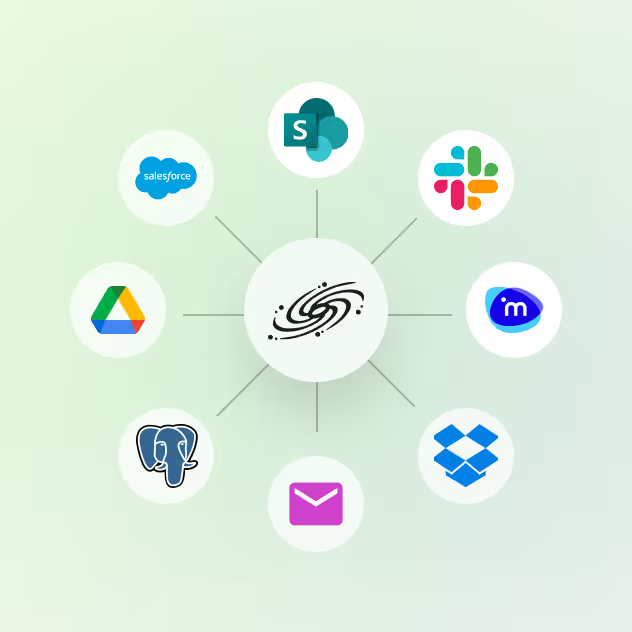
And this, in a nutshell, is the difference between external (web) data and a company’s internal data. Internal data is created to be used. Being able to find it later is an afterthought. Data created internally may or may not end up in a corporate database—much of the data is buried in email, Slack, WebEx, Teams, Confluence, Tableau, and numerous other locations (a phenomenon known, unsurprisingly, as information scatter). While the final work product may make it into a database, the notes, discussions, and debates that led up to that final product are as hard to find as the Ark of the Covenant in Raiders of the Lost Ark.
Although finding work information is much less dangerous than finding the Ark in Raiders (and also way less exciting), it makes up for the increased safety with massively increased frustration. Knowledge workers spend 1.5-2 hours per day just hunting for data. That’s the equivalent of losing one full workday every week. The cost of that data scavenger hunt is enormous.
Why Is Internal Data So Hard to Find?
We have a large and ever-growing collection of tools designed to make it easy to communicate with other people and preserve the content of those communications as data: email, Slack, Teams, WebEx, and so on. We have tools that will automatically transcribe meetings and save those notes for us (sometimes we even know where the notes are saved). We have the ability to create documents, charts, and images with greater ease than ever before.
Organizing this information is almost impossible. There’s just too much and it’s changing too fast. Trying to find a particular item in a multi-person Slack conversation from one week ago is difficult, from a few weeks ago almost impossible. Multiply that across all the different channels and conversations and it’s easy to see that it’s not just the amount of information that’s exploding—the number of places to look is also growing exponentially.
AI to the Rescue? Not So Fast!
The fundamental assumption behind most search solutions is that the data was created with the intent to be found. As we’ve discussed, that’s not the case with internal data.
Many AI systems solve the problem by assuming that the AI is being trained on your data. This has three problems: first, anything you teach an AI, the AI can reveal. That’s not necessarily what you want happening with your internal data. Second, even if you were willing to train the AI on your data, how would you do it? As we discussed above, the data is scattered across multiple apps and technologies—if you could easily pull it all together, this whole problem would be much simpler! And finally, new data is constantly being created, so the AI training can never keep up.
Some systems require you to put all your data into a vector database. Aside from the expense and complexity of adding yet another database to your environment, we haven’t solved any of the other data access and consolidation problems.
Yet other AI systems want you to upload your data to their servers. Now we’re back to the data security problem only on steroids—not only can the AI reveal information to anyone who asks nicely, we also have to worry about vendor data breaches. Plus, before we can upload data, we still have the problems of pulling all that data together from diverse sources and keeping up with new data.
Changing Assumptions
The key underlying assumption behind almost all systems is that we must bring the data to the AI. That’s fine on the web, where data is intended to be easily found, indexed, and retrieved on demand. But that assumption is deadly given what we know about internal data. Instead of bringing data to the AI, we need to bring the AI to the data.
When we bring AI to the data, the data stays in place: no uploading or bulk copying (Zero-ETL). The AI is not being trained on your data; rather, it is only being used to analyze and organize data according to very specific instructions. The AI does not add your data to its knowledge base.
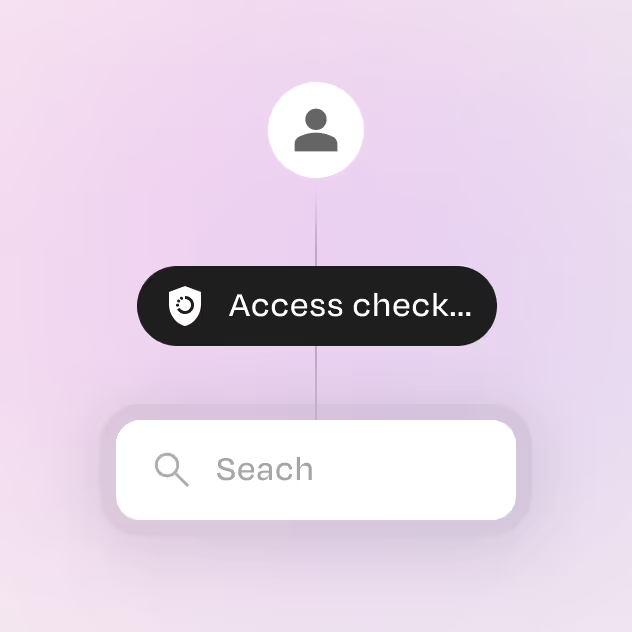
This is SWIRL’s approach. SWIRL runs in the cloud or completely on-premises, including in air-gapped systems. It securely connects your diverse data sources to the AI of your choice. SWIRL figures out the intent of your questions and enables you to ask follow-up questions. It will even suggest possible follow-ups for you.
When you want to find data that is meant to be found, there are plenty of good choices. When you need to find data that wasn’t created to be found, there’s SWIRL.
SWIRL ends the data scavenger hunt and gives you back that lost day. To find out how SWIRL can help you find your internal data, contact SWIRL today.