.png)
It'll Only Take Five Minutes is Killing Search: It Doesn't Need To
Search is broken in most enterprises, and the way it's broken is subtle. It's not that search doesn't work. It's that search works just well enough to feel acceptable while silently consuming enormous amounts of time. The five-minute search that turns into twenty minutes. The document you know exists but can't locate. The answer that's in the system somewhere but requires three different queries across two platforms to surface.
These are not edge cases. They are the daily experience of knowledge workers across industries. And the cumulative cost is staggering. IDC research has consistently found that workers spend roughly 30% of their time searching for information. In a 40-hour week, that's 12 hours. Not searching productively. Searching inefficiently, repeatedly, and often unsuccessfully.
The Scalability Problem Nobody Talks About
Most enterprise search implementations are designed for a data environment that no longer exists. They were built when organizations had fewer systems, fewer data types, and less volume. Today's environment is fundamentally different. Cloud platforms, collaboration tools, CRMs, ERPs, legacy databases, file shares, email archives - the number of distinct data sources in a typical enterprise has grown dramatically, and most search tools haven't kept pace.
Scaling traditional search means scaling complexity. More connectors. More maintenance. More inconsistency in results across systems. More time spent by workers triangulating between interfaces. The search experience degrades as the data environment grows, which is exactly backwards from what organizations need.
SWIRL's Approach: Search That Scales With the Enterprise
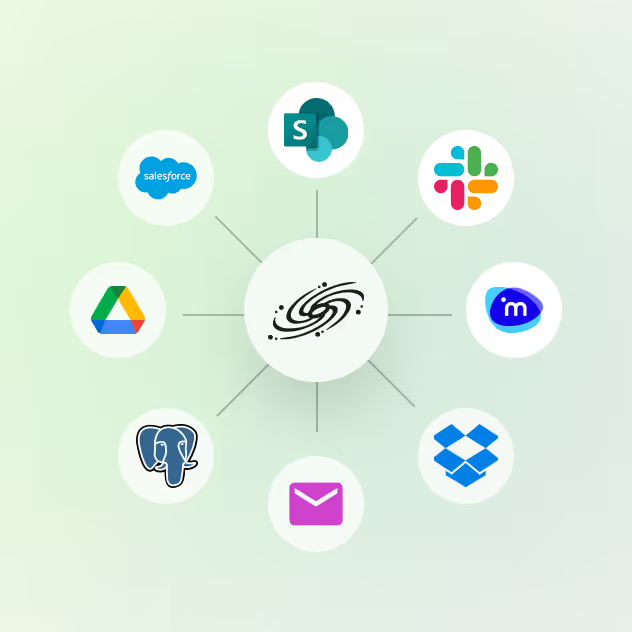
SWIRL is built for the modern data environment. It connects to over 100 data sources simultaneously, searches them in parallel, and returns ranked, deduplicated results through a single interface. As new systems are added to the enterprise, SWIRL extends to cover them without requiring workers to learn new search behaviors or IT to build custom integrations from scratch.
The result is a search capability that actually improves as the organization grows, rather than one that struggles to keep up. That's not just a better user experience. It's a strategic advantage.